
Why Global Companies Choose a Single Chauffeur Partner Worldwide
A multinational once counted its ground-transportation vendors and stopped at forty-three. A different local operator in nearly every city. Each with its own standard, its own invoice, its own way of interpreting “luxury,” and its own quiet method of failing. The travel team spent more hours managing cars than the executives spent riding in them. Procurement had spreadsheets. Assistants had phone trees. Nobody had peace of mind. The fix was never going to be a slightly better local vendor. The fix was a single worldwide chauffeur partner.
That story is not rare. It is the default condition for many global organizations that grew their ground transportation the same way they grew everything else: market by market, contact by contact, until the system itself became the problem. What begins as flexibility ends as fragmentation. What begins as local knowledge ends as inconsistent experience. And what begins as a series of reasonable decisions ends with executives arriving in one city composed and in the next city already managing disappointment before the meeting has even started.
The pattern is familiar to anyone who has sat in a travel or procurement seat long enough. A strong local relationship in the home market. A trusted contact in London. A recommendation that worked once in Singapore. Another that seemed adequate in Dubai. Over time the list lengthens. Each addition feels rational in isolation. Collectively they create a system that requires constant supervision and still produces uneven results. The executive feels the unevenness most clearly. The travel team absorbs the administrative weight. The organization pays for both.
Global companies that have moved past this pattern share a quiet recognition. Ground transportation is not a commodity to be sourced independently in every market. It is a continuous layer of the travel experience. When that layer is held by one partner who can deliver the same standard everywhere, something fundamental changes. The executive stops gambling. The travel team stops firefighting. The organization stops paying the hidden tax of managing forty-three different ways to be let down.
The Real Cost of Fragmentation
The visible costs of a fragmented vendor list are easy to measure: multiple invoices, varying rates, duplicated administrative effort, the hours spent reconciling exceptions. The invisible costs are heavier and more corrosive. An executive who has come to trust the service in New York lands in a secondary market and encounters a different vehicle standard, a different level of preparation, a different sense of whether the person at the curb understands the assignment. The trust does not transfer. It has to be rebuilt from zero, or it simply evaporates.
That evaporation has consequences. A leader who arrives already managing disappointment is not the same leader who arrives composed and ready. The first minutes on the ground set a tone that can linger through the morning’s meetings. In high-stakes travel, those minutes are not trivial. They are part of the performance. Fragmentation quietly taxes that performance every time the market changes.
Travel managers absorb the residual friction. They become the human interface between incompatible systems. They chase status updates across time zones. They explain to a principal why the car that appeared in Geneva did not match the one that appeared in Singapore. They spend evenings reconciling failures that should never have reached the passenger. Over time, the role of the travel team shifts from strategic support to perpetual recovery. That is not a sustainable use of talent, and it is not what most organizations intended when they first authorized local ground contracts.
There is also the quieter risk of uneven privacy and security posture. Different providers interpret discretion differently. Some treat confidentiality as a professional obligation. Others treat it as a preference. Some brief their drivers carefully. Others leave the human element to chance. For organizations that move board members, deal teams, or public figures, that variance is not theoretical. It is exposure. A single partner with a consistent standard for professional chauffeurs, vehicle presentation, and operational discipline removes the need to re-evaluate the human and security layer in every city.
One Standard, Everywhere It Matters
The core value of a single worldwide chauffeur partner is not coverage on a map. Coverage is necessary but insufficient. The real value is the delivery of one experience. Across more than 1,200 cities, Unique II Worldwide holds the same expectations for how a transfer is prepared, how a chauffeur presents, how a vehicle is maintained, and how the unexpected is handled. An executive who trusts the service in New York should find precisely the same service in Geneva, Jakarta, Dubai, or São Paulo. The company stops gambling on a new provider every time someone lands somewhere new.
Consistency of this kind is not accidental. It is the product of defined criteria applied to every market: vehicle age and condition, chauffeur screening and training, real-time operational oversight, and communication discipline. Local knowledge remains essential. Traffic patterns, FBO procedures, and cultural expectations differ from city to city. But local knowledge is exercised inside a shared standard rather than allowed to redefine the standard. The result is continuity. The executive does not have to recalibrate expectations with every border crossing.
That continuity shows up in small, decisive moments. The vehicle is already in position when the aircraft door opens. The chauffeur already understands the preferred level of interaction. The route has already been evaluated against current conditions. The cabin is quiet, prepared, and ready for either focused work or genuine recovery. None of these details require the passenger to ask. They are simply present. When they are present in every market, the ground layer of the journey stops being a variable and starts being infrastructure.
For corporate travel programs, this continuity is operational relief. The same briefing language works everywhere. The same escalation path works everywhere. The same quality threshold is visible at the curb whether the landing is at a familiar FBO or a first-time destination. The mental overhead of managing variability disappears. Attention returns to the work the travel was meant to support.
Accountability That Actually Lands
One partner also means one point of accountability. A single 24/7 operations center coordinates every trip, in every city, in real time. A single team answers for the outcome. There is no finger-pointing between local vendors when something slips, because there are no local vendors to point at. For a procurement team or a travel director, that clean line of responsibility is worth as much as the service itself.
Accountability shows up in practical ways. When a flight is diverted, the same operational layer that tracked the original arrival adjusts the vehicle and communicates the change. When a last-minute itinerary shift occurs, the same team that holds the original brief updates the chauffeur and the route. The client organization does not have to locate a new contact in a new city and hope the message arrives in time. The system already contains the information and the authority to act.
This structure also changes the nature of post-trip review. Issues, when they occur, are owned rather than dispersed. Patterns can be identified and corrected across the network rather than treated as isolated local failures. Over time, the relationship becomes one of continuous improvement rather than perpetual negotiation of exceptions. That is the difference between a vendor list and a partner. One creates more work. The other removes it.
The Person at the Curb Is the Service
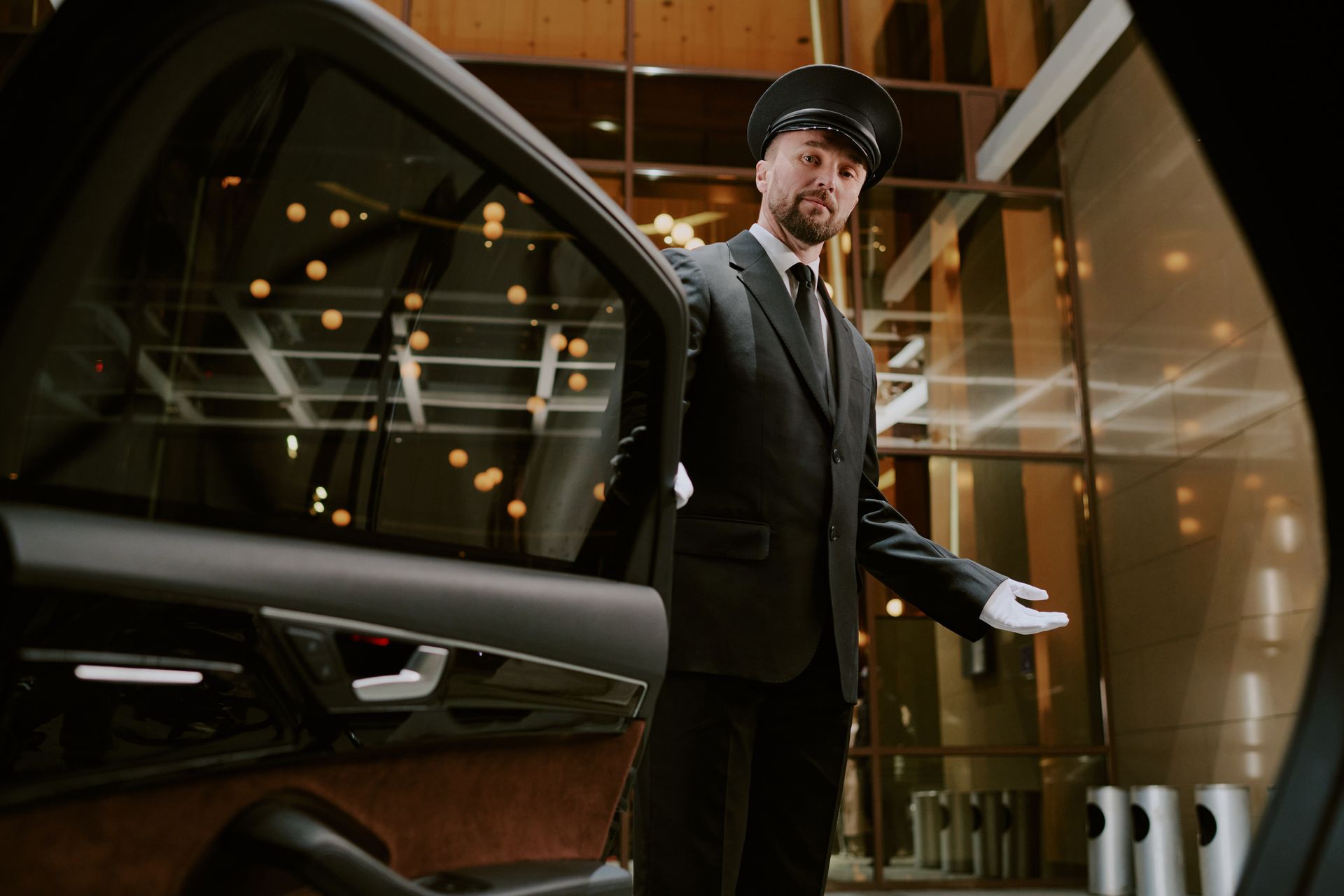
The consistency reaches all the way to the curb. Whether in the home market or halfway around the world, every chauffeur is a screened, trained career professional held to the same exacting standard. The person meeting the client abroad is indistinguishable in caliber from the one at home. This is not a claim about uniforms or scripts. It is a claim about judgment, presence, and the quiet competence that high-stakes travelers notice within the first thirty seconds.
A professional chauffeur understands when conversation is welcome and when silence is the higher form of care. They understand how to protect the content of a call made from the back seat. They understand how to stage a vehicle so that the transition from aircraft or terminal feels controlled rather than exposed. They arrive already briefed on the itinerary, already oriented to the preferred protocols, already prepared to adjust without requiring direction from the passenger. That preparation is the difference between a ride and a transfer that protects the executive’s focus and composure.
Unique II Worldwide treats the chauffeur role as a profession rather than a temporary assignment. Screening is rigorous and ongoing. Training continues beyond the initial hire. Performance is evaluated against the same standard in every market. The result is a human layer that does not degrade when the client crosses a border. For organizations that move people whose time and privacy carry real weight, that reliability of presence is often the deciding factor. The vehicle matters. The operations center matters. But the person who opens the door is the final and most personal expression of the standard.
Privacy and Reliability as Operating Principles
Global companies that choose a single partner are rarely choosing only for convenience. They are choosing for the protection of privacy and the assurance of reliability under pressure. Different local providers interpret discretion differently. Some treat confidentiality as non-negotiable. Others treat it as optional. A single partner with a consistent culture of discretion removes the variance. Conversations that occur inside the vehicle remain there. Movements that should stay low-profile stay low-profile. The operational posture does not change with the city.
Reliability is tested most clearly when plans break. Flights land early or late. Weather holds extend. Meetings jump across town with little notice. In a fragmented model, each of those events becomes a separate recovery exercise with a separate local contact. In a single-partner model, the same operations center that was already tracking the flight has already begun the adjustment. The vehicle repositions. The chauffeur is updated. The client receives information rather than silence. The transfer continues to feel intentional even when the underlying variables have shifted.
This is where deep knowledge of travel logistics becomes visible without being announced. The backend of executive and private aviation movement (real-time flight tracking, FBO coordination, route intelligence, and proactive communication) is not improvisation. It is infrastructure. Unique II Worldwide’s model is built so that the client experiences the result of that infrastructure rather than its complexity. The care is in the preparation. The security is in the consistency. The reliability is in the ability to absorb change without transferring the burden to the passenger.
Vehicles and Terminals That Do Not Degrade
The same principle holds for the vehicle and the private terminal. A uniformly maintained luxury fleet and established FBO relationships worldwide mean the experience never degrades when the client crosses a border, the one place fragmented programs almost always break. Newer-model vehicles, pre-assignment inspections, and consistent presentation standards travel with the network. The cabin that supports focus in one city supports it in the next.
For private aviation travelers, the relationship with the FBO is often the final and most vulnerable link. A partner that already has established access protocols, staging practices, and communication pathways with ground crews can deliver a transfer that begins at the aircraft rather than at a public curb. That continuity is difficult to replicate when every market requires a new introduction and a new set of local arrangements. A single partner carries those relationships forward so the client does not have to rebuild them every time the itinerary changes.
The fleet itself is treated as an extension of the standard rather than the centerpiece of the story. Capacity scales to the assignment (sedan, executive SUV, or larger platform) while the underlying quality does not. Presentation remains consistent. Maintenance remains rigorous. The passenger is never asked to accept a different level of readiness simply because the city has changed. That refusal to degrade is part of what makes a single worldwide partner feel different from a collection of local arrangements.
What the Switch Actually Feels Like
Organizations that consolidate ground transportation with one worldwide partner describe a change that is both practical and cultural. The practical change is measurable: fewer vendors, cleaner invoices, fewer status-chasing calls, fewer recovery conversations after a transfer that did not meet the expected standard. The cultural change is quieter and often more valuable. Executives stop bracing for variability. Travel teams stop treating every new city as a fresh risk assessment. The ground layer of the journey becomes something the organization can rely on rather than something it must continuously manage.
That reliability compounds. An executive who experiences the same professional presence, the same vehicle standard, and the same operational calm in successive cities begins to treat the service as infrastructure rather than as a series of individual bookings. The mental space previously occupied by uncertainty is returned to the work. For companies that move senior people frequently and under time pressure, that return of focus is not a soft benefit. It is a competitive one.
Travel managers notice a different kind of relief. The phone stops ringing with the same class of problems. The evenings spent reconciling local failures become rarer. The relationship with the ground partner shifts from transactional to collaborative. Updates arrive before they are requested. Adjustments happen before they become visible to the passenger. The system begins to feel like an extension of the travel team rather than another set of external variables to supervise.
The Decision Behind the Decision
Global companies choose one chauffeur partner for the same reason they standardize anything that matters: consistency, accountability, and the end of managing forty-three ways to be disappointed. They choose it because the alternative, however familiar, extracts a continuous cost in time, attention, and residual risk. They choose it because the people they move deserve a ground experience that matches the care taken with the rest of the itinerary.
Unique II Worldwide exists as that partner. Across more than 1,200 cities, the standard is held. The operations center remains continuous. The chauffeurs remain professionals. The vehicles remain current. The privacy posture remains consistent. The response to change remains proactive rather than reactive. None of this is announced at the curb. It is simply present. The executive steps into a vehicle that feels expected. The travel team receives updates instead of crises. The organization stops paying the hidden tax of fragmentation.
In the end, the decision is less about cars than about the quality of presence, care, and operational depth that travels with the client. A single worldwide partner makes that quality durable. It makes it portable. It makes it something the company can plan around rather than hope for. For organizations that have counted their vendors and recognized the cost of the count, that is not a convenience. It is the correction.
The companies that make the switch rarely describe it as a procurement victory. They describe it as the moment the ground stopped being a variable. The flights still change. The weather still intervenes. The meetings still shift. But the transfer no longer adds its own layer of uncertainty. That is the quiet outcome of choosing one partner who can hold the standard everywhere it is needed. Unique II Worldwide is built for exactly that outcome, on every trip, in every city, without exception.
Consolidate your ground travel with one worldwide chauffeur partner.
Reserve with Unique II Worldwide at uniquetwoworldwide.com or
call our 24/7 team today.